Revision
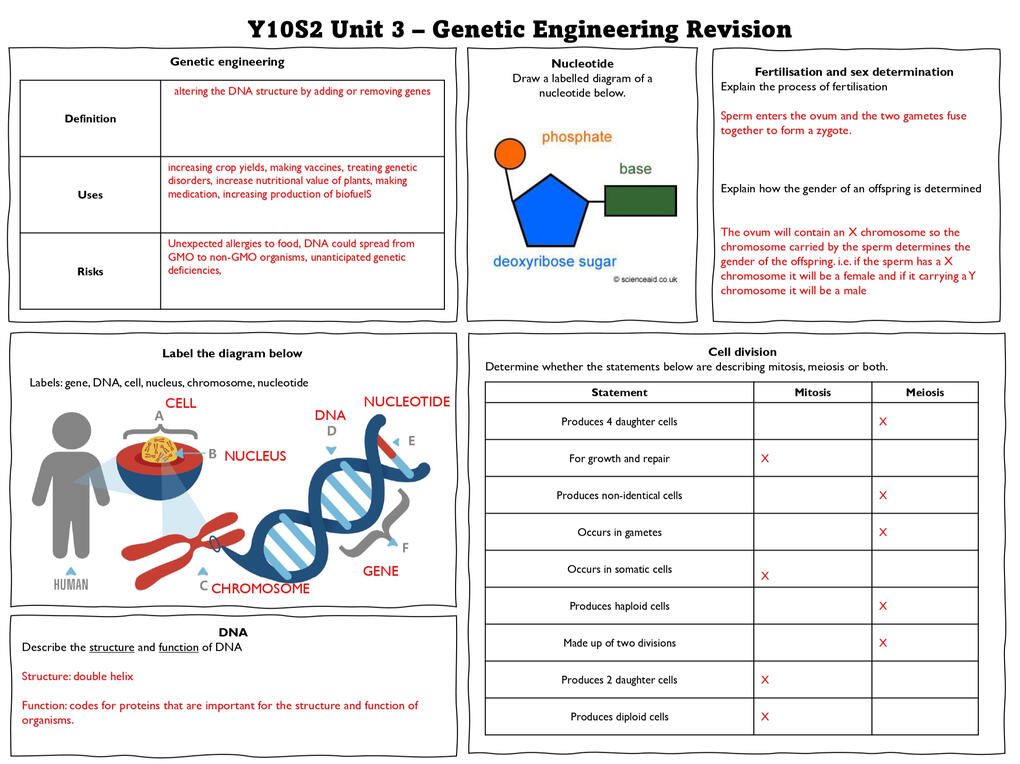
I can define genetic engineering.
Genetic engineering is the process of directly modifying an organism's DNA to alter its characteristics or abilities. This can involve adding, removing, or changing specific genes.I can list two uses for genetic engineering.Creating genetically modified crops that are resistant to pests or diseases.
Producing insulin for diabetes treatment through genetically modified bacteria.
I can describe two risks of genetic engineering.Unintended environmental consequences, such as harm to non-target species or reduced biodiversity.
Ethical concerns, particularly when applied to humans, regarding unintended side effects or inequality.
I can define the terms: deoxyribonucleic acid (DNA), chromosome, and gene.DNA: A molecule that carries the genetic instructions used in growth, development, and functioning of living organisms.
Chromosome: A structure made of DNA and proteins that contains many genes. Humans have 23 pairs of chromosomes.
Gene: A segment of DNA that codes for a specific protein or function.
I can explain where DNA is found.
DNA is found in the nucleus of eukaryotic cells, packaged into chromosomes. In prokaryotic cells, DNA is found in the cytoplasm.I can explain the role of DNA.
DNA contains the genetic instructions for the development, functioning, and reproduction of all living organisms. It provides the code for creating proteins.I can describe the structure of DNA.
DNA is structured as a double helix, where two strands coil around each other. These strands are made of a sugar-phosphate backbone and nitrogenous bases.I can name the components of a nucleotide.A phosphate group
A deoxyribose sugar
A nitrogenous base (adenine, thymine, cytosine, or guanine)
I can identify two processes of cell division; mitosis and meiosis.Mitosis: A process of cell division that results in two genetically identical diploid cells.
Meiosis: A process of cell division that results in four genetically varied haploid gametes.
I can explain the purpose of mitosis.
Mitosis is used for growth, repair, and asexual reproduction. It ensures that each daughter cell receives a full set of chromosomes.I can explain the purpose of meiosis.
Meiosis produces gametes (sperm and eggs) for sexual reproduction, reducing the chromosome number by half to ensure offspring inherit a correct set of chromosomes.I can list the stages of meiosis I and meiosis II in the correct order.Meiosis I: Prophase I, Metaphase I, Anaphase I, Telophase I
Meiosis II: Prophase II, Metaphase II, Anaphase II, Telophase II
I can explain what fertilisation is.
Fertilisation is the process where a male sperm cell fuses with a female egg cell, resulting in the formation of a zygote with a full set of chromosomes (diploid).I can explain the difference between males and females in terms of chromosomes.
Males have one X and one Y chromosome (XY), while females have two X chromosomes (XX).I can explain how the sex of an offspring is determined.
The sex of an offspring is determined by the sex chromosome carried by the sperm. An X chromosome results in a female (XX), while a Y chromosome results in a male (XY).I can explain that autosomal inheritance relates to traits that are inherited on the autosomal chromosomes.
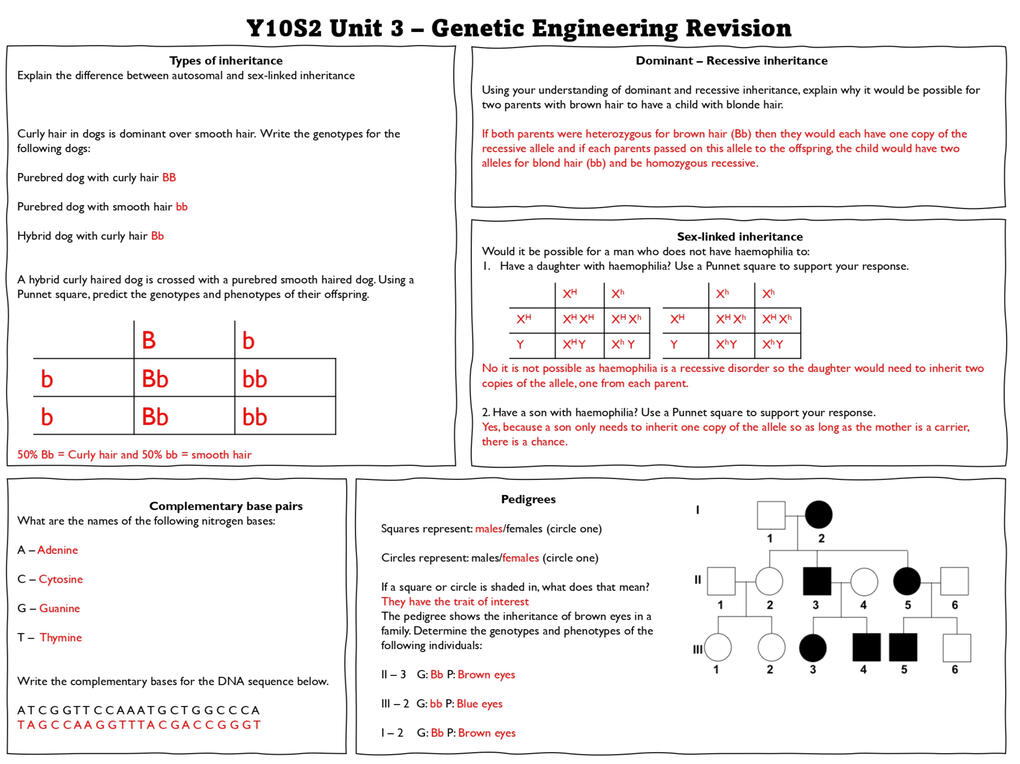
Autosomal inheritance refers to traits that are passed down through the non-sex chromosomes (chromosomes 1-22). Both males and females inherit autosomal traits equally.I can describe alleles in relation to genes and chromosomes.
Alleles are different forms of a gene found at the same position (locus) on a chromosome. Each individual inherits two alleles for each gene, one from each parent.I can correctly state an individual's genotype and phenotype in a scenario.Genotype: The genetic makeup of an individual, e.g., BB or Bb.
Phenotype: The observable characteristics resulting from the genotype, e.g., brown eyes.
I can explain the difference between dominant and recessive inheritance.Dominant inheritance: Only one dominant allele (e.g., B) is needed for the trait to be expressed.
Recessive inheritance: Both alleles must be recessive (e.g., bb) for the trait to be expressed.
I can explain the relationship between DNA, chromosomes, and genes.
Genes are segments of DNA that code for specific traits. DNA is packaged into chromosomes, which are located in the nucleus of cells. Chromosomes carry genes.I can construct a model of deoxyribonucleic acid (DNA).
A DNA model would include a double helix with a sugar-phosphate backbone and nitrogenous bases (adenine pairs with thymine, cytosine pairs with guanine).I can explain the double helix configuration of DNA.
The double helix is formed by two strands of DNA winding around each other, held together by complementary base pairs.I can explain how the four different types of nitrogen bases form complementary base pairs.
Adenine (A) pairs with thymine (T), and cytosine (C) pairs with guanine (G) through hydrogen bonds.I can differentiate between diploid and haploid number.Diploid: Cells that have two sets of chromosomes (e.g., somatic cells with 46 chromosomes in humans).
Haploid: Cells that have one set of chromosomes (e.g., gametes with 23 chromosomes in humans).
I can differentiate between somatic cells and gametes.Somatic cells: Body cells that are diploid and undergo mitosis.
Gametes: Sex cells (sperm and eggs) that are haploid and undergo meiosis.
I can explain the difference between mitosis and meiosis.
Mitosis produces two identical diploid cells, while meiosis produces four genetically varied haploid cells.I can describe what happens in each stage of meiosis I and meiosis II.Meiosis I: Homologous chromosomes are separated, leading to two haploid cells.
Meiosis II: Sister chromatids are separated, resulting in four haploid cells.
I can explain how meiosis creates genetic variation.
Meiosis introduces genetic variation through crossing over in Prophase I and independent assortment during Metaphase I, which leads to new combinations of genes in gametes.I can explain that genetic information is passed on to offspring from both parents by fertilisation.
During fertilisation, the sperm and egg each contribute half of the offspring’s genetic material, combining to form a unique individual.I can describe how combinations of dominant and recessive alleles produce different genotypes and phenotypes.Genotype: The combination of alleles (e.g., BB, Bb, or bb).
Phenotype: The observable trait, with dominant alleles being expressed if present, and recessive traits only appearing if both alleles are recessive.
I can use Punnett squares correctly to predict genotypes and phenotypes of offspring.
Punnett squares are used to calculate the probability of offspring inheriting specific genotypes and phenotypes based on the parents’ alleles.I can recall the difference between males and females in terms of their chromosomes.
Males have XY sex chromosomes, while females have XX sex chromosomes.I can explain that sex-linked inheritance relates to traits that are inherited on the sex chromosomes.
Sex-linked inheritance refers to traits that are carried on the X or Y chromosome. X-linked traits are more common because the X chromosome carries more genes.I can explain the difference between X and Y-linked inheritance.X-linked inheritance: Traits carried on the X chromosome (e.g., hemophilia).
Y-linked inheritance: Traits carried on the Y chromosome, which are passed from father to son.
I can identify some conditions that are passed through sex-linked inheritance.
Examples include color blindness and hemophilia, both of which are X-linked conditions.I can explain what a pedigree is.
A pedigree is a chart that tracks the inheritance of traits through generations of a family.I can determine the gender of individuals in a pedigree.
Males are represented by squares, and females are represented by circles in a pedigree chart.I can determine the phenotype of individuals in a pedigree.
The phenotype of an individual can be determined by whether they express the trait of interest (shaded in the pedigree).I can determine the genotype of individuals in a pedigree.
The genotype can often be inferred based on the patterns of inheritance in the family and whether the trait is dominant or recessive.I can draw a pedigree using information on individuals in a family.
A pedigree chart includes symbols for males and females, lines to show relationships, and shading to indicate the presence of a trait.
Traits Characteristics that are expressedGenes Parts of the chromosome that determine hereditary characteristics expressed in the offspring
Allele A version of a gene. Each person inherits one allele from each parent
Phenotype The physical characteristics that result from an interaction between the genotype and the environment
Genotype The combination of the alleles for a particular traitDominant trait A characteristic that needs only one copy of an allele to appear in the physical appearance of an organism
Recessive trait A characteristic that results from the inheritance of two identical alleles
Homozygous Having two identical alleles for a particular traitHeterozygous Having two different alleles for a particular trait; a carrier for the recessive trait
Autosome A chromosome that does not determine the sex of an organism
Sex chromosome A chromosome that determines the sex of an organism
Meiosis The process that results in formation of gametes with half the genetic material of the parent cell
Mitosis Process of cell division to provide growth and repairNucleotide A subunit of DNA; one base, one sugar, one phosphateCarrier A person who had the allele for a recessive trait that does not show in their phenotype
Punnet square A diagram that is used to predict the outcome of breeding organisms
Haploid A nucleus that contains one complete set of chromosomes (usually found in gametes)
Diploid A nucleus that contains two complete sets of chromosomes